

The stock market can seem complex with all the financial jargon, but one key concept that every investor should understand is the face value of a share. It’s a fundamental term that comes into play when you’re buying or selling shares, yet many investors may not fully grasp its meaning and importance. But What Is The Face Value of Share? and how it differs from other terms like market value. Let’s break it down.
Understanding Shares
Before diving into face value, let’s take a quick look at what shares are. Shares represent ownership in a company. When you buy a share, you’re essentially buying a small portion of the company. Shares are bought and sold on the stock market, and their value can fluctuate based on various factors like company performance, market conditions, and investor sentiment.
What is Face Value of Shares?
Face value, also known as par value or nominal value, is the initial cost of the share as determined by the company when it issues stock. This is the value printed on the stock certificate and doesn’t typically change throughout the life of the stock, except in specific situations like a stock split.
Face value is important for several reasons:
- It helps determine the dividend payouts to shareholders.
- It plays a role in calculating the share capital of the company.
- It’s used during stock issuance to determine the issue price.
Face Value vs Market Value
One of the most common misconceptions is that face value and market value are the same. In reality, they are quite different.
- Face Value is the fixed value set by the company when the share is issued.
- Market Value is the current price of the share in the stock market, which fluctuates based on supply and demand.
For example, a company may issue shares with a face value of $10, but due to market conditions, those shares could be trading for $50 on the stock exchange.
Role of Face Value in Stock Issuance
When a company goes public with an Initial Public Offering (IPO), it assigns a face value to its shares. This face value helps the company calculate the authorized share capital, which is the total amount it aims to raise by issuing shares. It’s crucial during share allocation and issuance, but beyond that, face value doesn’t usually affect the market price of the stock.
Face Value and Dividends
Dividends are payments made by a company to its shareholders, often derived from profits. Interestingly, dividends are often calculated based on the face value of the share and not its market value.
For instance, if a company declares a 10% dividend on a share with a face value of $10, the dividend payout would be $1 per share, regardless of whether the share’s market value is $50 or $100.
Face Value and Stock Splits
A stock split is a corporate action in which a company divides its existing shares into multiple shares to boost liquidity. When a stock split occurs, the face value of each share is reduced proportionally.
For example, if a company declares a 2-for-1 stock split on shares with a face value of $10, the new face value would be $5 per share, and shareholders would have double the number of shares.
Face Value and Bonds
The term face value is also used in the world of bonds. In this context, it refers to the principal amount that the bondholder will receive when the bond matures. Unlike shares, where the market price fluctuates, the face value of a bond remains constant throughout its tenure.
Importance of Face Value
Financial Reporting and Accounting
The face value of shares plays a significant role in financial reporting. It represents the base value used to calculate the total value of issued shares in a company’s financial statements. For example, if a company has issued 1 million shares with a face value of $1 each, the total capital stock recorded will be $1 million. This value helps in determining the company’s equity base and provides a starting point for calculating earnings per share (EPS) and other financial metrics.
Legal and Regulatory Aspects
The face value is also critical from a legal standpoint. Companies are often required to issue shares with a face value to comply with legal standards and regulations. It ensures transparency and consistency in financial reporting and prevents companies from undervaluing their shares below their nominal value.
Impact on Shareholders
For shareholders, the face value of shares might initially seem abstract, but it has practical implications. It provides a benchmark for understanding the initial value of their investments. However, it’s important to note that the market price of a share can fluctuate significantly from its face value due to various market conditions and company performance.
How Face Value Differs from Market Value?
Face Value
The face value is a static figure set when shares are first issued. It does not change regardless of market conditions or the company’s financial performance. This value is mainly used for accounting purposes and does not reflect the current market value of the share.
Market Value
In contrast, the market value of a share is the price at which it is currently trading on the stock exchange. This value fluctuates based on supply and demand, investor sentiment, and the company’s performance. The market value can be significantly higher or lower than the face value, depending on various external factors.
Factors Affecting Share Value Beyond Face Value
Company Performance
The financial health and performance of a company have a substantial impact on its share value. Strong earnings, revenue growth, and positive outlooks can drive the market price of shares well above their face value.
Economic Conditions
Broader economic conditions, such as inflation rates, interest rates, and economic growth, influence market prices. During economic booms, share prices may exceed face value, while in recessions, they may fall below it.
Investor Sentiment
Market sentiment and investor confidence play a critical role in determining share prices. Positive news about a company or industry can lead to an increase in market value, while negative news can depress share prices.
Relationship Between Face Value and Market Value
Book Value vs. Market Value
The face value contributes to the book value of a company’s equity. However, the market value provides a real-time snapshot of a company’s worth based on current trading conditions. Investors should consider both values when evaluating investment opportunities.
Implications for Corporate Actions
Companies may perform actions such as stock splits or reverse stock splits that affect the face value of shares. A stock split, for instance, increases the number of shares while decreasing the face value proportionately, without changing the overall market value.
How is face value calculated?
Face value is not calculated based on any external factors like market conditions or company performance. Instead, it is assigned by the company when shares or bonds are initially issued. The face value is typically a fixed value that remains constant throughout the life of the share or bond unless the company decides to change it through corporate actions like a stock split.
Here’s how face value is determined in different contexts:
For Shares:-When a company is incorporated and decides to issue shares, it assigns a face value to each share, usually a small amount (e.g., $1, $10, or a similar figure).
The company’s capital structure will reflect the total face value of all issued shares. For example, if a company issues 1 million shares with a face value of $1 each, the total face value of the shares will be $1 million.
For Bonds:-For bonds, the face value (also called par value) is the amount that the bond issuer agrees to repay the bondholder at maturity. This is usually set in round figures like $100, $1,000, or $10,000.
Bondholders are also paid interest on the face value, which is specified in the bond agreement. For instance, a bond with a face value of $1,000 and a 5% interest rate will pay the bondholder $50 annually until maturity.
Face value vs book value?
Face Value and Book Value are two important financial concepts that are often used to assess the value of a company’s shares or financial instruments. While they may seem similar, they represent different aspects of a company’s financial structure. Let’s break down the differences:
Face Value (Par Value or Nominal Value)
Definition: The face value of a share or bond is the nominal or original value assigned to it when it is issued. For shares, it is usually a small, fixed amount like $1, $10, or any other value chosen by the company. For bonds, it represents the amount that will be repaid to the bondholder at maturity.
Purpose: The face value is mostly for accounting and legal purposes. It does not change over time and does not fluctuate with the company’s performance or market conditions.
Example: If a company issues 1 million shares with a face value of $10 each, the total face value of the shares is $10 million. However, the market value could be much higher or lower depending on how the shares are traded.
Book Value
Definition: A company’s book value is the value of its net assets (total assets minus total liabilities) as recorded on the company’s balance sheet. Simply, it represents what the company would be worth if all its assets were sold off and its liabilities paid off.
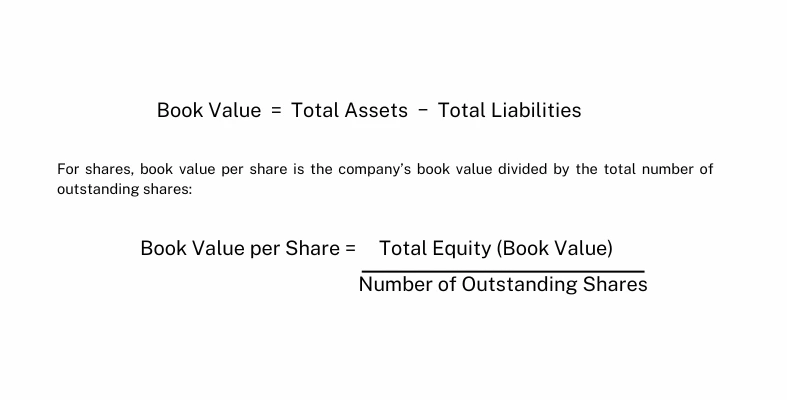
- Purpose: Book value gives investors an idea of the underlying worth of the company based on its historical costs and financial position. It’s an important measure for value investors who look for companies trading below their book value.
- Example: If a company has total assets of $50 million and liabilities of $20 million, the book value would be $30 million. If the company has 1 million shares outstanding, the book value per share would be $30.
Key Differences Between Face Value and Book Value
| Aspect | Face Value | Book Value |
| Definition | Initial or nominal value assigned to shares or bonds | The value of the company’s net assets |
| Purpose | Used for accounting and legal purposes | Indicates the company’s intrinsic worth |
| Calculation | Set by the company when shares/bonds are issued | Total assets minus total liabilities |
| Change Over Time | Remains constant unless modified (e.g., stock splits) | Changes based on the company’s financials |
| Relevance to Investors | Primarily used for issuing new shares or bonds | Useful for assessing the financial health of the company |
Conclusion on What Is The Face Value of Share?
In summary, the face value of shares is a fundamental financial concept that represents the nominal value of a share as stated on its certificate. While it serves as a basis for accounting and legal purposes, the market value of shares, which fluctuates based on various factors, is more indicative of the actual worth of an investment. Understanding both face value and market value is crucial for making informed investment decisions and comprehending financial reports.
For those seeking to deepen their knowledge of financial concepts and enhance their investment strategies, exploring additional resources and staying informed about market trends can provide valuable insights.
FAQs
What happens if a company’s share price drops below face value?
If the market price drops below the face value, it indicates poor market sentiment, but the face value itself doesn’t change unless the company takes specific actions.
How does face value affect the return on investment (ROI)?
ROI is typically based on the market value and not the face value, but dividends may be based on face value, indirectly affecting returns.
Can face value change after the IPO?
Yes, face value can change through actions like stock splits or consolidations, although this is rare.
Is face value important for day-to-day trading?
Not really. Daily trading is based on market value. Face value mainly matters for corporate actions and dividends.
How does face value impact taxation?
Face value can influence capital gains tax calculations, but usually, market value is more relevant for tax purposes.

