

Option trading is a powerful tool in the financial markets, offering traders the opportunity to profit from both rising and falling prices. However, this potential comes with significant risks. Without proper risk management, even experienced traders can face substantial losses. In this comprehensive guide, we’ll explore strategies, principles, and techniques for how to Do Risk Management in Option Trading.
What is an Option?
Options Trading is a type of financial trading where you buy and sell options contracts instead of actual stocks. An option is a contract that gives you the right (but not the obligation) to buy or sell a stock (or other asset) at a specific price on or before a certain date.
There are two main types of options:
-
Call Option – Gives you the right to buy the stock.
-
Put Option – Gives you the right to sell the stock.
Key Terms:
-
Strike Price – The price at which you can buy or sell the asset.
-
Premium – The cost you pay to buy the option.
-
Expiry Date – The date when the option contract expires.
-
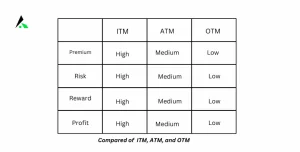
In the Money (ITM) – When exercising the option is profitable.
-
Out of the Money (OTM) – When exercising the option is not profitable.
Also Read: Option Buying VS Option Selling: Which is better?
How Options Trading Works?
Options trading involves buying and selling contracts that give you the right, but not the obligation, to buy or sell an asset at a set price before a specific date. There are two types: call options (buy) and put options (sell). Traders use options for speculation or hedging. While offering high profit potential, options also carry significant risk if not managed properly. Let’s break it down with a simple example:
Suppose a stock is trading at ₹100.
-
You buy a Call Option with a strike price of ₹105 expiring in 1 month.
-
If the stock goes up to ₹115 before expiry, you can exercise the option to buy at ₹105 and sell at ₹115 – earning a profit.
-
If the stock stays below ₹105, you can let the option expire – you only lose the premium you paid.
Understanding Risk in Options Trading
Before managing risk, it’s essential to understand where the risk lies:
- Leverage Risk: Small price movements can result in significant gains or losses.
- Time Decay (Theta): The option value decreases as expiration approaches.
- Volatility Risk (Vega): Changes in implied volatility impact premiums.
- Directional Risk (Delta): Incorrect price direction results in a loss.
- Liquidity Risk: Low volume may cause difficulty in entering or exiting trades.
1. Define Your Risk Tolerance and Capital Allocation
- Set Risk Capital Limits: Never trade with money you can’t afford to lose. Define a specific portion of your capital (often 2%–5%) to allocate per trade.
- Example: If your trading capital is ₹1,00,000, don’t risk more than ₹2,000–₹5,000 per trade.
- Portfolio Diversification: Avoid putting all your money into one trade or strategy.
2. Use Stop Loss and Profit Targets
- Protect Against Unexpected Moves
- Stop-loss level: Exit trade at a predetermined loss level.
- Target profit level: Secure profits when the price hits your target.
In options, stop-loss can be set as:
- Price-based (premium drops to a level)
- Time-based (cut losses after a certain days)
- Technical-based (price breaks support/resistance)
3. Choose the Right Strategy According to Market Conditions
Different option strategies have different risk profiles. Choosing the wrong strategy can increase your risk.
Low Risk Strategies:
- Covered Calls
- Protective Puts
- Iron Condors
- Credit Spreads
High Risk Strategies:
- Naked Calls or Puts
- Long Straddle or Strangle (in low IV)
- Short Options (without hedge)
Match strategy to market:
- High volatility → Spreads, condors
- Trending market → Directional strategies
- Uncertain market → Long straddle/strangle
Also Read: Top 10 Best Option Trading Strategies
4. Hedge Your Positions
Offset Risk with Other Instruments: Hedging is a core component of professional risk management.
- Use inverse positions (e.g., buy put to hedge long stock)
- Use spreads (e.g., bull call spread vs. long call)
- Buy VIX calls or index puts during uncertainty
- Diversify across different sectors or assets
5. Monitor the Greeks
Understanding and managing the “Greeks” helps in controlling exposure.
- Delta: Price sensitivity – affects directional risk
- Gamma: Change in Delta – measures convexity
- Theta: Time decay – impacts long options
- Vega: Volatility impact – critical before events
- Rho: Interest rate sensitivity – minor, but relevant
Use Greeks to adjust or rebalance positions to reduce risk exposure.
Learn Details: Option Greeks: Insider Tips to Navigate Market Volatility Like a Pro
6. Avoid Overtrading and Revenge Trading
Emotions can destroy even the best risk management plan.
- Set daily/weekly loss limits
- Avoid doubling down on losing trades
- Take breaks after significant losses
- Journal your trades to evaluate risk vs. reward
Discipline is your strongest risk management tool.
7. Use Position Sizing Wisely
Do not risk your entire capital on a single trade.
- Small Lot Sizes: Especially for beginners
- Lot Multiples: Scale gradually, based on trade success
- Margin Awareness: Don’t over-leverage your margin
Good position sizing reduces drawdown in case of bad trades.
8. Manage Event and Gap Risk
Avoid holding naked options during events like:
- Earnings announcements
- Budget or Fed meetings
- War or geopolitical news
Event risk can lead to slippage or gap openings, which could bypass stop losses. Use hedged trades or close positions before such events.
9. Understand the Psychology of Risk
- Avoid FOMO (Fear of Missing Out).
- Stick to your strategy; don’t chase trades.
- Take consistent, small profits over large, risky bets.
- Accept losses as part of the game
Mastering emotional control is as crucial as technical skill in managing risk.
10. Learn When to Exit – Both in Profit and Loss
One of the most overlooked parts of risk management is exit discipline.
- Partial exit: Book partial profits to reduce exposure.
- Time-based exit: Don’t hold options till expiry unless part of the strategy.
- Trailing stop-loss: Lock in profits when the trend is favorable.
Exiting correctly avoids turning profits into losses.
11. Backtest and Simulate Before Going Live
Use virtual trading platforms to test your strategy under real market conditions.
- Tools: Sensibull, Thinkorswim PaperMoney, TradingView simulators.
- Analyze past performance, drawdowns, and win ratios.
- Adjust based on data, not emotions.
Backtesting builds confidence and reveals strategy flaws without risking real capital.
Pros of Options Trading:
-
Requires less capital than buying shares.
-
Can be used to hedge (protect) other investments.
-
Offers high return potential with limited risk (for buyers).
Risks in Options Trading:
-
Complex compared to regular stock trading.
-
Premium can become worthless if the market moves against you.
-
Sellers (writers) of options can have unlimited risk.
Conclusion on How to Do Risk Management in Option Trading?
Risk management in option trading isn’t optional — it’s a necessity. Whether you’re a beginner or an expert, your focus should be on preserving capital, protecting profits, and practicing discipline. By following the above principles, you create a robust framework for sustainable and consistent trading in the options market.
Remember, profits are built over time, not overnight. Trade smart, trade safe.
FAQs
- What is the biggest risk in option trading?
Time decay and leverage are the biggest threats, especially to option buyers. - Can I trade options safely as a beginner?
Yes, but start with simple strategies like covered calls or protective puts and use small capital. - Is stop loss useful in options?
Absolutely! It helps limit losses before they get out of hand. - How many options trades should I do at once?
Stick to a manageable number—2 to 5 trades depending on your experience and capital. - What is the safest option strategy?
Covered call and protective put are considered low-risk strategies, great for beginners.
Best Price Action Trading Book
You can read our book Price Action Trading Beginner to Advance to boost your trading knowledge. This book covers basic to advanced price action trading concepts, including trading strategies, candlestick patterns, chart patterns, technical analysis, volume analysis risk management, and trading psychology. you can buy the book from Amazon or Flipkart.

