

Swing trading is a popular trading strategy that focuses on capturing short- to medium-term price movements in financial markets. Unlike day trading, which involves making multiple trades within a single day, swing trading aims to capitalize on price swings over several days to weeks. This method enables traders to capitalize on market trends without requiring constant monitoring. In this post we will know what is swing trading and how to learn to earn money from it?
What is Swing Trading?
Swing trading is a short- to medium-term trading strategy used in financial markets like stocks, forex, or cryptocurrencies. The main goal of swing trading is to capture price movements or “swings” that happen over a few days to several weeks.
Key Characteristics of Swing Trading
- Holding Period: Typically ranges from a few days to a few weeks.
- Focus on Trends: Swing traders look for short-term trends or patterns and aim to profit from upward or downward price movements.
- Technical Analysis: Swing traders rely heavily on technical indicators such as moving averages, support and resistance levels, and trendlines.
- Risk Management: Properly placing stop-losses is essential to minimize potential losses.
- Market Flexibility: Works well in stocks, forex, cryptocurrencies, and commodities.
How to Learn Swing Trading?
- Understand Market Basics: Before diving into swing trading, it is crucial to grasp fundamental market concepts, including price action, trends, and volume. A strong foundation will help traders make informed decisions.
- Master Technical Analysis: Swing traders rely on technical indicators to identify potential entry and exit points. Some essential tools include:
- Moving Averages (SMA, EMA): Help in trend identification.
- Relative Strength Index (RSI): Indicates overbought or oversold conditions.
- MACD (Moving Average Convergence Divergence): Shows momentum shifts.
- Bollinger Bands: Help identify volatility and price breakouts.
- Learn Chart Patterns: Recognizing chart patterns like head and shoulders, double tops and bottoms, and flags can improve trade accuracy. Understanding how price action behaves within these patterns allows traders to enter trades with high-probability setups.
- Develop a Trading Strategy: A solid trading strategy should include:
- Entry Rules: Define conditions that trigger a trade.
- Exit Strategy: Decide when to take profits or cut losses.
- Risk-Reward Ratio: Maintain a favorable risk-reward setup, typically 1:2 or higher.
Back test Your Strategy
Before risking real money, back testing on historical data helps evaluate strategy performance. Many platforms, such as Trading View and Meta Trader, offer back testing features.
- Open a Demo Account: Most brokers provide demo accounts where beginners can practice trading with virtual funds. This step helps in gaining confidence before transitioning to live trading.
- Start Small with a Live Account: Once comfortable with a strategy, traders can begin with a small capital investment and gradually increase their exposure as they gain experience.
How to Make Money with Swing Trading?
- Choose the Right Stocks or Assets: Not all stocks or assets are ideal for swing trading. Look for:
- High Liquidity: Stocks with a high trading volume ensure smooth trade execution.
- Volatility: Assets with price swings offer better profit potential.
- Clear Trends: Stocks following strong upward or downward trends are preferred.
- Identify Entry and Exit Points: Successful swing trading depends on precise timing. Traders should look for:
- Breakouts above resistance levels
- Pullbacks to support levels
- Indicators confirming trend continuation
- Use Stop-Loss and Take-Profit Levels: Managing risk is crucial in swing trading. Traders should always set a stop-loss order to limit losses and a take-profit level to secure gains.
- Follow Market News and Events: Swing traders should stay informed about economic data, earnings reports, and global events that can influence market movements.
- Maintain Trading Discipline: Emotions can be a trader’s worst enemy. Following a well-defined plan and avoiding impulsive decisions is key to long-term success.
Best Swing Trading Strategies
Trend Following Strategy
Trend following is a trading strategy where traders capitalize on sustained market movements in one direction. Instead of predicting reversals, they identify and ride ongoing trends until signs of a reversal appear.
- Identify the Trend: Use moving averages (e.g., 50, 100, 200 EMA), trendlines, or indicators like ADX to confirm an uptrend or downtrend.
- Enter the Trade: Buy in an uptrend when the price makes higher highs and higher lows, or sell in a downtrend when lower highs and lower lows form.
- Use Risk Management: Place stop-loss orders below recent swing lows (for long trades) or above swing highs (for short trades) to limit losses.
- Ride the Trend: Hold the trade as long as the trend continues, using trailing stops or moving averages to exit when momentum weakens.
Breakout Trading
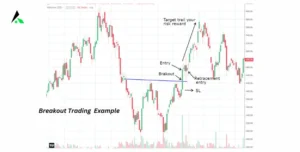
Breakout trading is a strategy where traders aim to capitalize on significant price movements that occur when an asset breaks through a key support or resistance level. This breakout signals the potential start of a new trend, offering profit opportunities.
- Identifying Breakout Levels: Traders look for assets consolidating within a range, marked by support (lower boundary) and resistance (upper boundary) levels.
- Volume Confirmation: A genuine breakout is often accompanied by a surge in trading volume, indicating strong market interest.
- Entry Points: Traders enter a position as soon as the price breaks above resistance (for a bullish breakout) or below support (for a bearish breakout).
- Risk Management: Setting stop-loss orders just below the breakout level (for bullish trades) or above it (for bearish trades) helps minimize losses in case of false breakouts.
- Trend Continuation: Breakouts often lead to significant price movements, allowing traders to ride the trend for potential gains.
Also learn:
Pullback Trading
Pullback trading is a strategy where traders capitalize on temporary price retracements within a prevailing trend. These retracements, or “pullbacks,” occur when the price moves briefly against the dominant trend, offering an opportunity to enter the market at a more favorable price.
- Trend Identification: The first step is to identify a strong, ongoing trend—either upward or downward.
- Pullback Recognition: Look for a temporary reversal or correction in the trend. This could be a dip in an uptrend or a rise in a downtrend.
- Entry Points: Use technical tools like Fibonacci retracements, moving averages, or trendlines to pinpoint optimal entry levels during the pullback.
- Confirmation: It’s crucial to confirm the pullback’s end before entering a trade. This can be done through candlestick patterns, volume analysis, or other technical indicators.
- Risk Management: Set stop-loss orders below the pullback low (in an uptrend) or above the pullback high (in a downtrend) to limit potential losses.
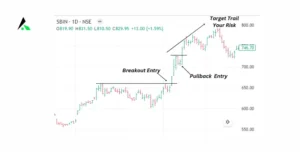
Pullback trading aligns with the broader market trend, increasing the likelihood of success. It also offers a better reward-to-risk ratio, as traders enter at a more advantageous price. This strategy requires patience, discipline, and a solid understanding of technical analysis. Would you like to explore specific tools or examples for pullback trading?
Moving Average Crossover
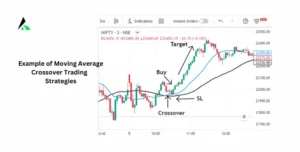
A trade is initiated when a short-term moving average crosses above or below a long-term moving average, signaling a change in trend direction. The moving average crossover is a popular technical analysis tool used by traders to identify potential buy and sell signals. Here’s a breakdown:
What are Moving Averages?
Moving averages smooth out price fluctuations by calculating the average price of an asset over a specific period. This helps to identify the underlying trend. There are different types, with the most common being the Simple Moving Average (SMA) and the Exponential Moving Average (EMA).
The Crossover Concept:
A moving average crossover occurs when two moving averages with different periods intersect. Typically, a shorter-term moving average (more sensitive to recent price changes) is compared to a longer-term moving average (less sensitive).
Trading Signals:
Bullish Signal (Buy): When the shorter-term moving average crosses above the longer-term moving average, it suggests a potential uptrend.
Bearish Signal (Sell): When the shorter-term moving average crosses below the longer-term moving average, it suggests a potential downtrend.
Common Crossovers:
Traders often use combinations like the 50-day and 200-day moving averages, or shorter-term combinations for faster signals. The “Golden cross” is when the 50 day SMA crosses above the 200 day SMA. The “Death cross” is the opposite.
Limitations:
Moving averages are lagging indicators, meaning they reflect past price action. They can produce false signals, especially in choppy or sideways markets. Moving average crossovers help traders visualize trend changes and make informed trading decisions.
Read More:
Common Mistakes to Avoid in Swing Trading
- Overtrading: Trading too frequently can lead to increased transaction costs and emotional stress.
- Ignoring Stop-Loss Orders: Failing to use stop-loss protection can result in significant losses.
- Lack of Patience: Many traders exit profitable trades too early due to fear or lack of confidence in their strategy.
- Poor Risk Management: Risking too much capital on a single trade can wipe out an entire account.
- Trading Without a Plan: A structured trading plan helps maintain discipline and consistency.
Pros and Cons of Swing Trading
Pros:
- Requires less time than day trading.
- Higher profit potential than long-term investing.
- Can be done part-time.
Cons:
- Overnight risk exposure.
- Requires strong technical analysis skills.
- Subject to market volatility.
Tax Implications of Swing Trading
Swing trading gains are usually taxed as short-term capital gains. Consult a tax advisor to optimize tax liabilities.
Conclusion on What is Swing Trading And How to Learn Make Money from It?
Swing trading is an effective way to capitalize on short-term market fluctuations while avoiding the intensity of day trading. By learning technical analysis, practicing with demo accounts, and following disciplined strategies, traders can successfully navigate the markets and generate consistent profits. However, risk management and patience are essential to long-term success.
FAQs
Is swing trading suitable for beginners?
Yes, with proper education and practice, beginners can succeed in swing trading.
How much capital is needed for swing trading?
A minimum of $2,000–$5,000 is recommended for effective swing trading.
What are the best stocks for swing trading?
Stocks with high liquidity and volatility, like tech and large-cap stocks, are ideal.
How long should I hold a swing trade?
Typically, 2 days to 2 weeks, depending on market conditions.
Can I swing trade part-time?
Yes, swing trading is suitable for those with limited time compared to day trading.
You can read our book Price Action Trading Beginner to Advance to boost your trading knowledge. This book covers basic to advanced price action trading concepts, including trading strategies, candlestick patterns, chart patterns, technical analysis, volume analysis risk management, and trading psychology. you can buy the book from Amazon or Flipkart.

