
In the stock market, many newcomers engage in options trading, but most end up losing money. This is primarily because they lack a solid understanding of the fundamentals of options trading and don’t possess complete knowledge in this area. Despite this, they invest significant sums in options, resulting in losses for many.
Another common mistake is buying call or put options solely based on their low cost. They opt for options with cheaper premiums, assuming they’re getting a good deal, only to regret their decision later.
So, if you’re aiming to avoid losses and make profits in options trading, this article is tailored for you. However, it’s essential to start by grasping the basics of option trading. Without a solid foundation, achieving success as an options trader will be challenging.
Hence, in this article, I’ll simplify the concepts of ITM (In The Money), ATM (At The Money), and OTM (Out of The Money) and discuss which is the preferable option. I’ll also explain the full meanings of ITM, ATM, and OTM, how they function, and which option holds more advantages for purchase.
What are ITM, ATM, and OTM?
In the stock market, there are option contracts with different strike prices known as ITM (In The Money), ATM (At The Money), and OTM (Out of The Money). These contracts can be either Call or Put options. In option trading, ITM means In The Money, OTM means Out of The Money, and ATM means At The Money. You can buy Call options (CE) and Put Options (PE) on ITM, ATM, and OTM. The prices of premiums for these three types of option contracts are different, and we will discuss why this is the case shortly.
Options trading involves two primary types of contracts: call options and put options. These financial instruments provide investors with the opportunity to speculate on the price movements of underlying assets without necessarily owning them.
Also Read: Top 10 Best Option Trading Strategies
What is Call option ?
Call option gives the holder the right, but not the obligation, to buy a specified quantity of the underlying asset at a predetermined price, known as the strike price, within a specified timeframe. This is advantageous when anticipating an increase in the asset’s value. If the market price surpasses the strike price, the investor can exercise the option, profiting from the difference.
What is Put option?
Put option grants the holder the right, but not the obligation, to sell a predetermined quantity of the underlying asset at the strike price within a specified timeframe. Put options are beneficial when expecting a decline in the asset’s value. If the market price falls below the strike price, the investor can exercise the option, profiting from the variance.
Both call and put options provide flexibility for hedging against market fluctuations and leveraging opportunities. Investors can use these instruments to manage risk, speculate on price movements, and enhance their overall investment strategies. However, it’s crucial to carefully assess market conditions, risk tolerance, and financial goals before engaging in options trading.
Basic Options Terms
Strike Price: The strike price is the set or predetermined price at which the options contract will have to be exercised.
Spot Price: The spot price is the latest price at which the options contract is being traded.
Intrinsic Value: The intrinsic value is the value expected by the buyer of an options contract given that he/she exercises the contract on a particular day. Intrinsic value is calculated by deducting the current price (spot price) from the set price of the currency (strike price) for the call option and vice versa for the put option. The intrinsic value of an option will always be positive or zero and it can not acquire a negative value.
Time Value: The Time value is also referred to as the Extrinsic value. It is the excess amount over and above an option’s intrinsic value. Time value decreases to zero over time as the option moves closer to expiration. This circumstance is called as time decay. Options premium depends on time to expiration. Options that would expire after a longer duration of time would be more expensive as compared to those expiring in the current month as the former would have more time value left, increasing the probability of trade going in your favour.
In The Money (ITM) Options
If an option contract possesses intrinsic value, it is referred to as being In The Money (ITM). In the case of a call option in ITM, the current spot price surpasses the strike price. Conversely, for a put option in ITM, the current spot price is lower than the strike price.
For example, If the current spot price is Rs 20,000 and there’s an option strike at Rs19,800, the intrinsic value would be Rs 20,000– Rs19,800= Rs 200. As it has intrinsic value, this option contract is considered an In The Money (ITM) call option.
ITM options usually have a higher premium than Out of The Money (OTM) and The Money (ATM) options. However, there is a higher likelihood of achieving anticipated profits because the premium comprises both intrinsic value and time value.
At The Money (ATM) Options
When an option contract doesn’t possess any intrinsic value, ATM options occur when the strike price aligns closely with the current market price. The option essentially hovers around the breakeven point.
For example, if the spot price of a currency pair denominated in INR is Rs 20,000, and the nearest strike price of an option is Rs19,950, the intrinsic value would be Rs 20,000– Rs 19,950= Rs 50. Consequently, this option is classified as At The Money (ATM).
ATM options require paying a moderate premium when compared to Out of The Money (OTM) and In The Money (ITM) options. However, the likelihood of achieving anticipated profits is reasonable since the premium comprises only time value and lacks intrinsic value.
Out of The Money (OTM) Options
When an option contract doesn’t possess any intrinsic value, it is referred to as an Out-of-The-Money (OTM) option. In the case of an OTM call option, the spot price is lower than the strike price. Conversely, for an OTM put option, the strike price is lower than the spot price.
For example, Given a spot price of Rs 20,000, if the strike price is Rs 20,100, the intrinsic value would be Rs 20,000 – Rs 20,100 = -100. A negative intrinsic value is treated as zero. An options contract with zero intrinsic value is categorized as an Out-of-The-Money (OTM) call option.
OTM options are more affordable compared to In-The-Money (ITM) options, as the premium includes only the time value. Opting for OTM is preferable when anticipating positive price movement in a currency, as it requires a lower upfront payment.
ITM ATM OTM Which is better?
Let’s understand which of these three (ITM, ATM, and OTM) is better, meaning which one involves more risk, which one is more advantageous, and how much money is required for each.
Below, we have compared ITM, ATM, and OTM to show which option is more favorable.
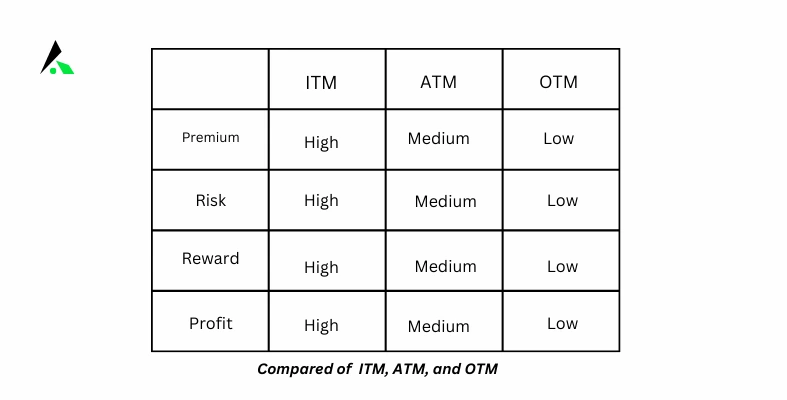
- Premium: When it comes to premiums, in-the-money (ITM) options require the highest premium, followed by a slightly lower premium for at-the-money (ATM) options, and the least amount is needed for purchasing out-of-the-money (OTM) options. Therefore, you will consistently find the price of OTM options to be more affordable, while the price of ITM options will always be relatively higher.
- Risk: The highest risk is associated with in-the-money (ITM) options, followed by a lower risk with at-the-money (ATM) options, and the least risk is found in out-of-the-money (OTM) options. This is because in ITM options, you have to invest the most money, in ATM options, it’s less, and in OTM options, you take the least risk with the lowest amount of money involved.
- Reward: The highest reward is found in in-the-money (ITM) options, followed by a lower reward in at-the-money (ATM) options, and the least profit is obtained in out-of-the-money (OTM) options. This means that in options where you invest more money, both risk and reward are high, while in options where you invest less money, both risk and reward are low.
- Profit: The highest probability of making money is in in-the-money (ITM) options, followed by a lower probability in at-the-money (ATM) options, and the least likelihood is in out-of-the-money (OTM) options. This occurs because the target price is reached first in ITM, followed by ATM, and lastly in OTM.
Also Read: Option Greeks : Insider Tips to Navigate Market Volatility Like a Pro
Risk and Reward: Weighing the Pros and Cons
Now that we’ve established the groundwork, let’s delve into the pros and cons of ITM, ATM, and OTM options.
Pros of ITM Options
- Reduced Risk: ITM options inherently carry lower risk since they have intrinsic value.
- Higher Probability of Profit: The option is already profitable, increasing the likelihood of a positive outcome.
Cons of ITM Options
- Higher Initial Cost: Purchasing ITM options requires a higher upfront investment.
- Lower Potential Returns: The profit potential may be limited compared to ATM or OTM options.
Pros of ATM Options
- Balanced Risk-Reward Profile: ATM options offer a middle ground, providing a balanced risk-reward ratio.
- Lower Initial Cost: Compared to ITM options, ATM options are more cost-effective.
Cons of ATM Options
- Market Uncertainty: The option is sensitive to market fluctuations, making it susceptible to increased risk.
Pros of OTM Options
- Lower Initial Investment: OTM options come with a lower initial cost, making them attractive for risk-averse traders.
- High-Profit Potential: If the market moves favorably, the returns on OTM options can be substantial.
Cons of OTM Options
- Higher Risk: The likelihood of the option expiring worthless is higher.
- Market Precision: Accurate market predictions are crucial for the success of OTM options.
Learn more details: Top 5 Risk Management Strategies for Traders
Choosing the Right Option for You
The decision between ITM, ATM, and OTM options ultimately depends on your risk tolerance, market analysis, and investment goals. Consider the following factors when making your choice:
Risk Appetite: Assess how much risk you’re comfortable with and choose the option type that aligns with your risk tolerance.
Market Outlook: Analyze the market conditions and make predictions based on thorough research.
Investment Goals: Define your investment objectives, whether it’s capital preservation, income generation, or aggressive growth.
Also Read: 10 Best Option Trading Tips
Conclusion
The choice between ITM, ATM, and OTM options is a nuanced decision that requires careful consideration. Each option type has its own set of advantages and disadvantages, and the key lies in aligning your choice with your unique financial goals and risk tolerance. By understanding the intricacies of ITM, ATM, and OTM options, you empower yourself to make informed decisions, setting the stage for a successful options trading journey. Remember, there’s no one-size-fits-all approach, and a well-thought-out strategy tailored to your preferences is the key to navigating the complexities of the options market.
FAQ’s :
Which option is more beneficial between ITM and OTM?
If you do not want to take much risk then OTM is good for you but if you want to earn more profit by taking risks then ITM is best for you.
Which option should be bought among ITM, ATM, and OTM?
There are both positive and negative sides to buying each option of ITM, ATM, and OTM. You should see how much money you have to pay for which option, which has more risk, which has more profit, only then you should buy ITM, ATM, or OTM.
Why option selling is costly?
Option selling can be costly due to the unlimited risk involved. When an investor sells an option, particularly a naked option, they expose themselves to potentially unlimited losses if the market moves against them. To mitigate this risk, sellers often need significant margin requirements. Additionally, market volatility and unpredictable price movements can contribute to increased costs and potential financial exposure.
Why option buying is not profitable?
Option buying can be less profitable because it comes with a time decay factor, known as theta decay. As options approach their expiration date, their value diminishes. If the underlying asset doesn’t move significantly, buyers may lose the entire premium paid for the option. Predicting both the direction and timing correctly is essential for profitable option buying.
Can option buyers make money?
Yes, option buyers can make money if their predictions about the underlying asset’s price movement are accurate. Profits arise when the market moves in the anticipated direction and the option’s value increases. However, timing is crucial, as options have an expiration date, and if the market doesn’t move as expected within that timeframe, buyers may face losses, including the premium paid for the option.
Can I start option trading with 5000 rupees?
While it’s technically possible to start option trading with 5000 rupees, it poses challenges. Options involve risks, and the capital may be insufficient to cover potential losses. Additionally, trading fees and transaction costs can significantly impact a small capital base. It’s crucial to thoroughly understand options, practice risk management, and consider starting with a larger amount to increase flexibility and manage potential losses effectively in the volatile options market.
Is it better to buy or sell options?
The decision to buy or sell options depends on your risk tolerance, market outlook, and strategy. Buying options offers limited risk but requires precise market timing. Selling options can provide income but involves higher risk due to potential unlimited losses. Both approaches have pros and cons, and the better choice depends on your financial goals, knowledge, and risk appetite.

